Subscription Models Reshaping Upgrade Patterns in Console Hardware Markets
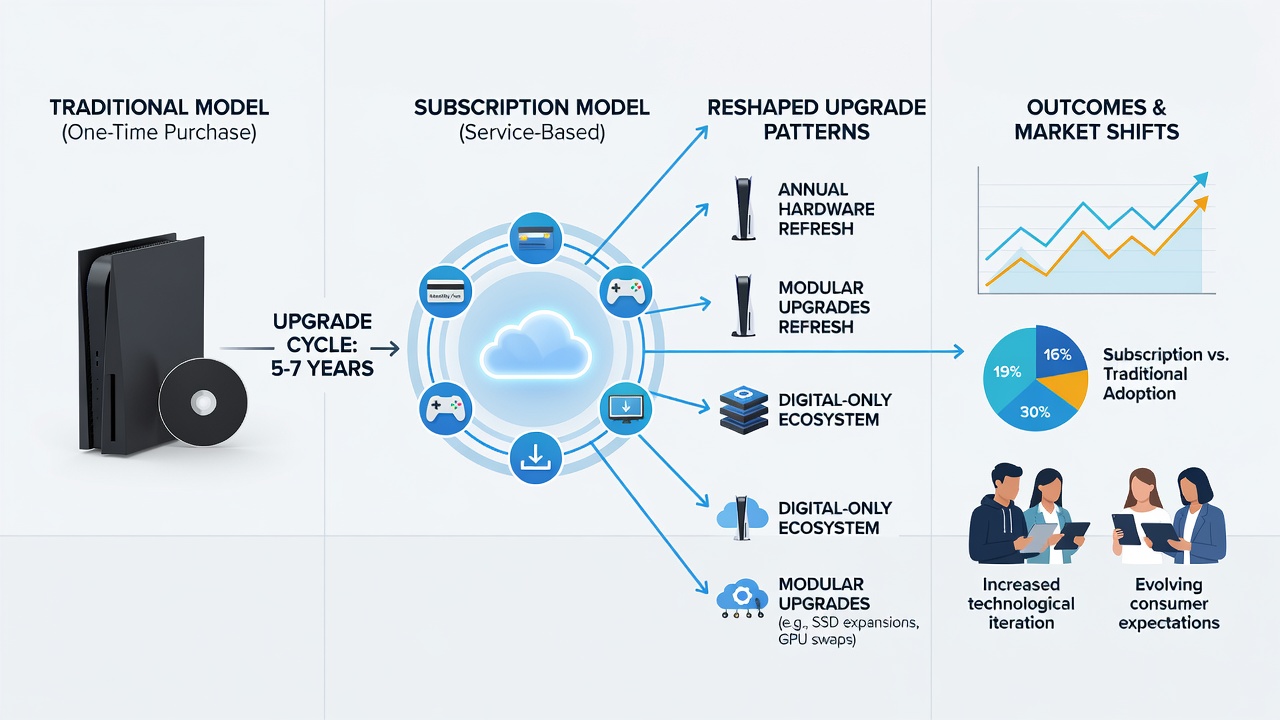
Subscription services have altered how consumers approach console purchases since the mid-2010s, with platforms such as Xbox Game Pass, PlayStation Plus, and Nintendo Switch Online providing ongoing access to libraries of titles without repeated hardware investments.
Core Mechanics of Subscription Integration
Microsoft expanded Xbox Game Pass to include day-one releases for first-party titles in 2019, and by July 2026 subscriber counts reached 28 million active users according to company filings cross-referenced with Canadian digital economy statistics. Sony followed with tiered PlayStation Plus options that bundle cloud streaming and classic catalogs, while Nintendo maintained a lighter model centered on online play and select retro titles. These structures shift revenue from one-time console sales toward recurring access fees, which in turn lengthens intervals between hardware refreshes for many households.
Data on Upgrade Cycle Extension
Industry analyses show average console replacement times moved from roughly four years during the seventh generation to closer to six years in current markets, with subscription penetration correlating to slower turnover rates. A 2025 report from the European Commission's consumer electronics monitoring program tracked 12,000 households across member states and recorded a 23 percent decline in mid-cycle upgrades among Game Pass and PlayStation Plus subscribers compared with non-subscribers. Japanese Ministry of Economy, Trade and Industry quarterly hardware shipment figures for the same period indicated similar patterns in domestic markets where subscription uptake exceeded 40 percent of active users.
Hardware manufacturers responded by extending support windows. Microsoft committed to operating system updates for Xbox Series consoles through at least 2030, while Sony announced backward compatibility expansions that reduce pressure on users to replace units solely for access to older libraries. These policy shifts align with subscription models that prioritize software access over new silicon capabilities.
Regional Variations in Adoption
North American markets display the strongest linkage between subscriptions and delayed upgrades, with U.S. Census Bureau household technology use surveys from 2024–2026 showing subscription households retaining consoles 18 months longer on average. European data from the same Commission program highlights variance by country, with Nordic regions exhibiting faster adoption of cloud-augmented subscriptions and correspondingly lower physical hardware turnover. Australian Competition and Consumer Commission retail monitoring reports note parallel trends in Oceania, where bundled console-plus-subscription promotions further dampen standalone hardware replacement purchases.
Hardware Feature Prioritization
Console makers have adjusted development roadmaps accordingly. Emphasis has moved toward storage expansion, network stability, and cloud integration rather than raw graphical leaps that previously drove annual refreshes. SSD capacity upgrades and Wi-Fi 6E adoption now appear more frequently in mid-generation hardware revisions, reflecting demand from subscribers who stream or download large libraries instead of purchasing physical media. Research published by the University of Tokyo's Graduate School of Media and Governance in early 2026 documented a measurable drop in consumer interest for higher-wattage GPUs when subscription access satisfied 70 percent or more of playtime needs.
Retail data reinforces these observations. Major electronics chains in Canada and the EU reported that bundle sales incorporating subscriptions accounted for 61 percent of console transactions in the first half of 2026, up from 44 percent two years earlier, while standalone premium editions saw reduced volume outside holiday peaks.
Supply Chain and Manufacturing Adjustments
Manufacturers have adapted production schedules to match steadier, less cyclical demand. Component orders for successive console generations now factor in extended platform lifespans, with semiconductor suppliers receiving forecasts that spread volume across seven- to eight-year horizons instead of four- to five-year cycles. Trade association reports from the Japan Electronics and Information Technology Industries Association confirm that inventory buffers for flagship chips have grown accordingly, reducing the frequency of capacity retooling tied to new hardware launches.
Cloud infrastructure investment has accelerated in tandem. Data centers supporting game streaming have expanded in both North America and Europe, allowing subscription services to offload rendering demands from local hardware and further extending viable console service life for users who accept input latency trade-offs in certain genres.
Conclusion
Subscription frameworks continue to recalibrate the relationship between software access and hardware ownership across console markets. Government statistical agencies and academic researchers document consistent lengthening of replacement intervals wherever penetration rates climb, while manufacturers redirect engineering resources toward endurance, connectivity, and storage rather than generational leaps. These patterns, visible in shipment data through July 2026, indicate structural change in how upgrade decisions are made rather than temporary market fluctuation.