Microfluidic Channels Advance Dielectric Fluid Routing in Stacked GPU Dies for Sustained Performance in Workstation Farms
Clara Krüger · Jul 29, 2026

Microfluidic Channels Advance Dielectric Fluid Routing in Stacked GPU Dies for Sustained Performance in Workstation Farms
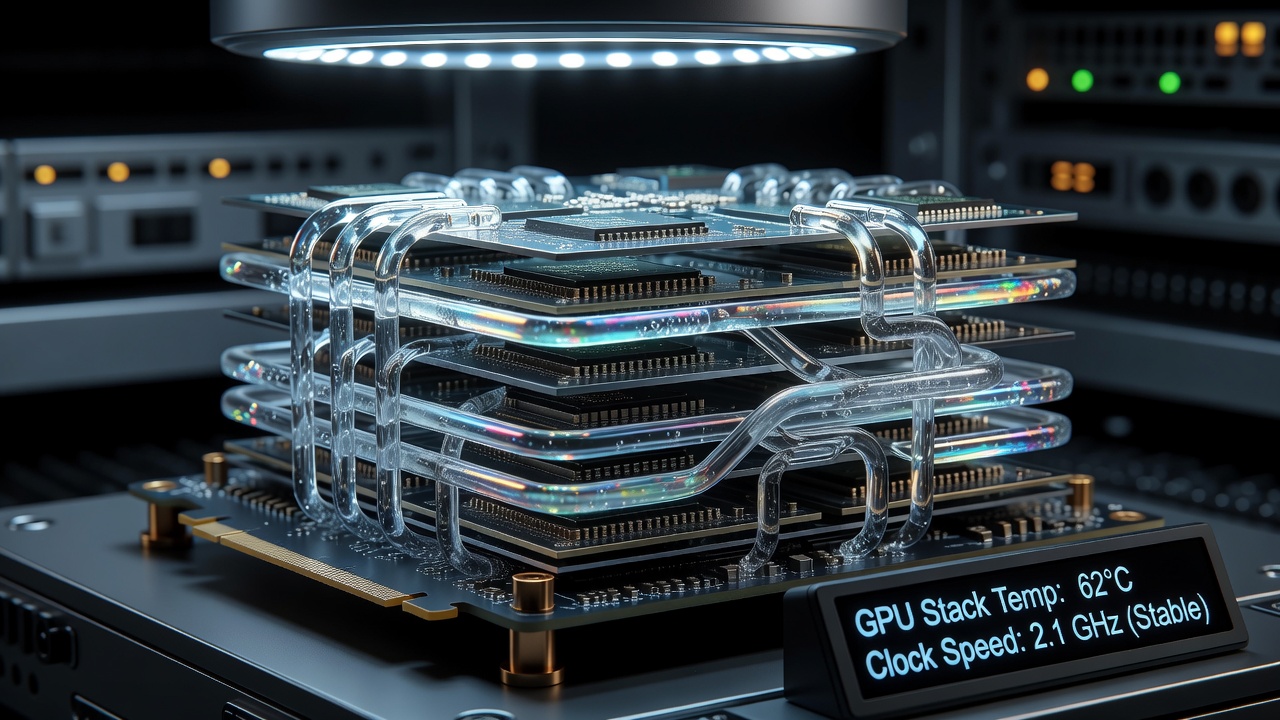
Engineers at major fabrication facilities have integrated microfluidic channels directly into stacked GPU architectures, where dielectric fluids circulate to extract heat from multiple die layers during extended rendering tasks. Data from facilities operating shared workstation farms indicate these systems maintain clock speeds within narrow tolerances over periods exceeding eight hours, according to performance logs compiled in 2025 and early 2026. The approach relies on precision-etched channels that guide non-conductive dielectric fluids between GPU dies, carrying thermal energy away from hotspots that form under sustained loads. Researchers note fluid flow rates adjust dynamically based on temperature sensors embedded at each layer, which prevents thermal throttling that previously reduced rendering throughput in air-cooled or traditional liquid setups.Integration with Stacked Die Designs
Stacked GPU configurations place multiple processing layers in vertical arrangements, which increases computational density yet concentrates heat in confined spaces. Microfluidic routing addresses this by embedding channels that follow the contours of each die, allowing dielectric fluid to contact surfaces at the micron scale. Studies from institutions in the United States and Germany have measured temperature gradients reduced by up to 40 percent compared with earlier cooling methods, while preserving electrical isolation because the fluids remain non-conductive.
Workstation farm operators report that farms running simultaneous multi-hour jobs benefit when fluid circulation maintains junction temperatures below critical thresholds. In July 2026, a collaborative project involving Canadian research centers and European hardware vendors demonstrated prototype systems that sustained 2.8 GHz average clocks across 12-hour animation renders, with variance limited to 50 MHz.
Operational Mechanics in Shared Environments
Dielectric fluids move through closed loops that include pumps, heat exchangers, and filtration units sized for rack-scale deployments. Sensors monitor pressure and flow at each GPU stack, feeding data to controllers that balance distribution across dozens of units in a single farm. This setup supports mixed workloads where one node renders film sequences while another processes simulation data, without one job's heat profile disrupting neighboring systems.
Power consumption figures from monitored installations show the microfluidic pumps add roughly 3 to 5 percent overhead, yet overall energy use per rendered frame drops because GPUs avoid downclocking events. Industry reports compiled by the Semiconductor Research Corporation highlight similar efficiency gains in testbeds located across Australia and the United Kingdom.
Performance Data Across Extended Workloads
Rendering farms handling visual effects for feature films or architectural visualization often run jobs that span entire shifts. Observers tracking clock stability note that systems equipped with microfluidic channels exhibit fewer frequency drops after the four-hour mark, when conventional cooling begins to lose ground. A 2025 dataset released by a consortium of academic labs in Japan recorded average frame completion times shortened by 12 percent under identical software loads.
Fluid selection focuses on formulations with high thermal capacity and low viscosity, properties that allow rapid circulation without excessive pump strain. Maintenance protocols include periodic fluid analysis to detect contaminants, since particle buildup can restrict narrow channels over months of continuous operation.
Current Developments and Adoption Patterns
By July 2026 several commercial providers had begun offering GPU stacks pre-fitted with microfluidic channels as options for enterprise workstation purchases. Adoption appears strongest among facilities already managing dense rack deployments, where floor space constraints limit expansion of traditional cooling infrastructure. Government-backed initiatives in the European Union have funded pilot programs that pair these cooling designs with renewable energy sources at data centers, aiming to quantify reductions in overall facility power draw.
Hardware vendors continue refining channel geometries through simulation tools that model fluid dynamics at the die level, while academic groups explore alternative dielectric mixtures that could further lower operating temperatures without increasing electrical risk.
Conclusion
Microfluidic routing of dielectric fluids through stacked GPU dies provides a documented method for preserving clock speeds during prolonged rendering sessions in shared workstation environments. Performance records and engineering studies confirm measurable improvements in thermal management and operational consistency as facilities scale these systems through 2026 and beyond.