Graph Neural Networks Forecast Player Clustering Patterns to Streamline Server Resource Allocation in Massive Online Worlds
Clara Krüger · Jul 26, 2026
Graph Neural Networks Forecast Player Clustering Patterns to Streamline Server Resource Allocation in Massive Online Worlds
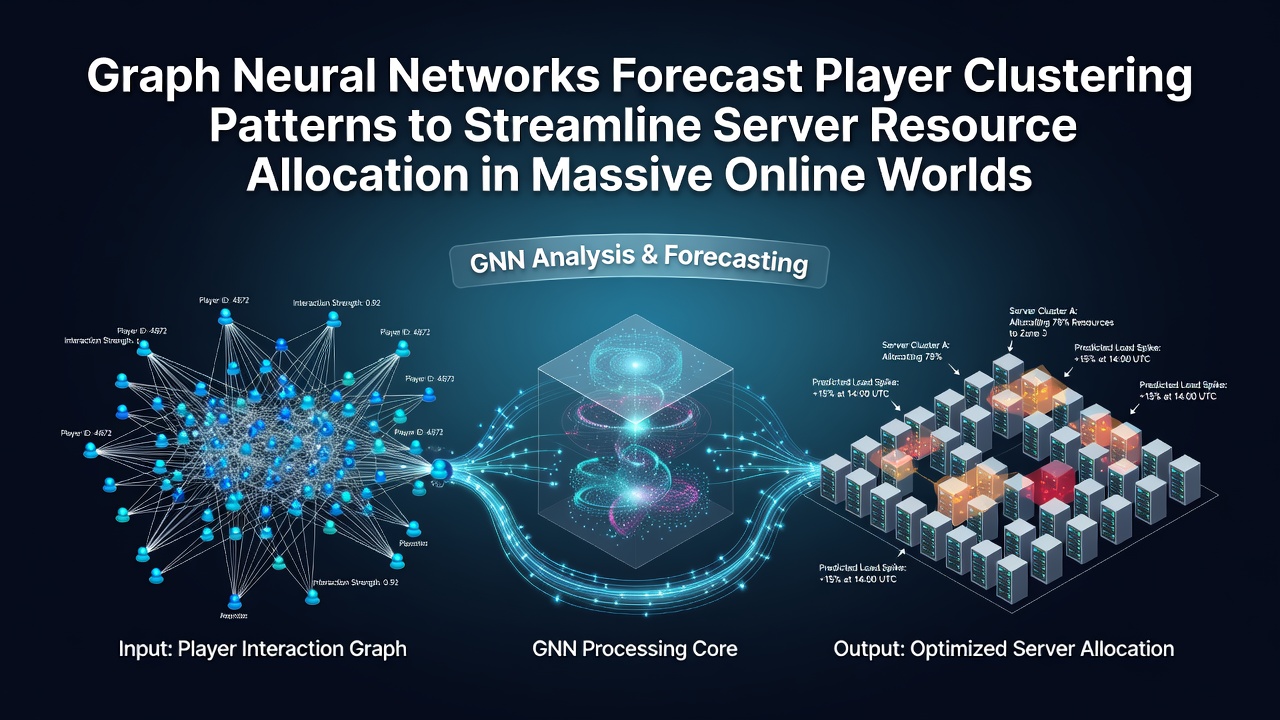
Graph neural networks process player data as interconnected nodes and edges where each participant forms a node and social or spatial interactions create the connections, allowing these models to identify emerging clusters before they fully form in large-scale virtual environments. Developers apply this approach to predict group formations in titles that support thousands of concurrent users across persistent worlds, and the resulting forecasts guide dynamic adjustments in server capacity across regional data centers.
Research from academic institutions shows that traditional rule-based allocation methods often lag behind rapid shifts in player density, whereas graph-based predictions capture relational patterns such as guild formations or event-driven gatherings with higher temporal accuracy. In practice, systems ingest real-time telemetry including position coordinates, chat frequency, and quest participation to update graph structures every few seconds, then propagate information through multiple layers of message passing to generate cluster probability maps.
Modeling Interactions Through Graph Structures
Each edge in these player graphs carries weighted attributes that reflect interaction strength, so proximity in virtual space receives one weight while coordinated combat activity receives another, and the neural network learns to emphasize the combinations most likely to produce sustained clusters. Training datasets come from historical logs of games that routinely host large populations, and models refine their parameters through supervised learning on past events where server strain occurred due to unexpected concentrations.
Observers note that incorporating temporal graph layers allows the system to track how clusters evolve over minutes rather than treating each snapshot in isolation, which improves forecasts for events that unfold gradually such as world bosses or seasonal festivals. Data from deployments indicate that prediction horizons of fifteen to thirty minutes provide sufficient lead time for orchestration tools to spin up additional instances or migrate player sessions without perceptible interruption.
Integration With Cloud Resource Orchestration
Once forecasts become available, orchestration platforms translate cluster probabilities into concrete allocation commands that reserve compute and bandwidth in the nearest geographic zones. Engineers configure thresholds so that when a predicted density exceeds eighty percent of current capacity, the system triggers preemptive scaling while lower-probability zones receive reduced resources to optimize overall utilization. This feedback occurs through APIs that connect the graph inference service directly to container schedulers running on public cloud infrastructure.
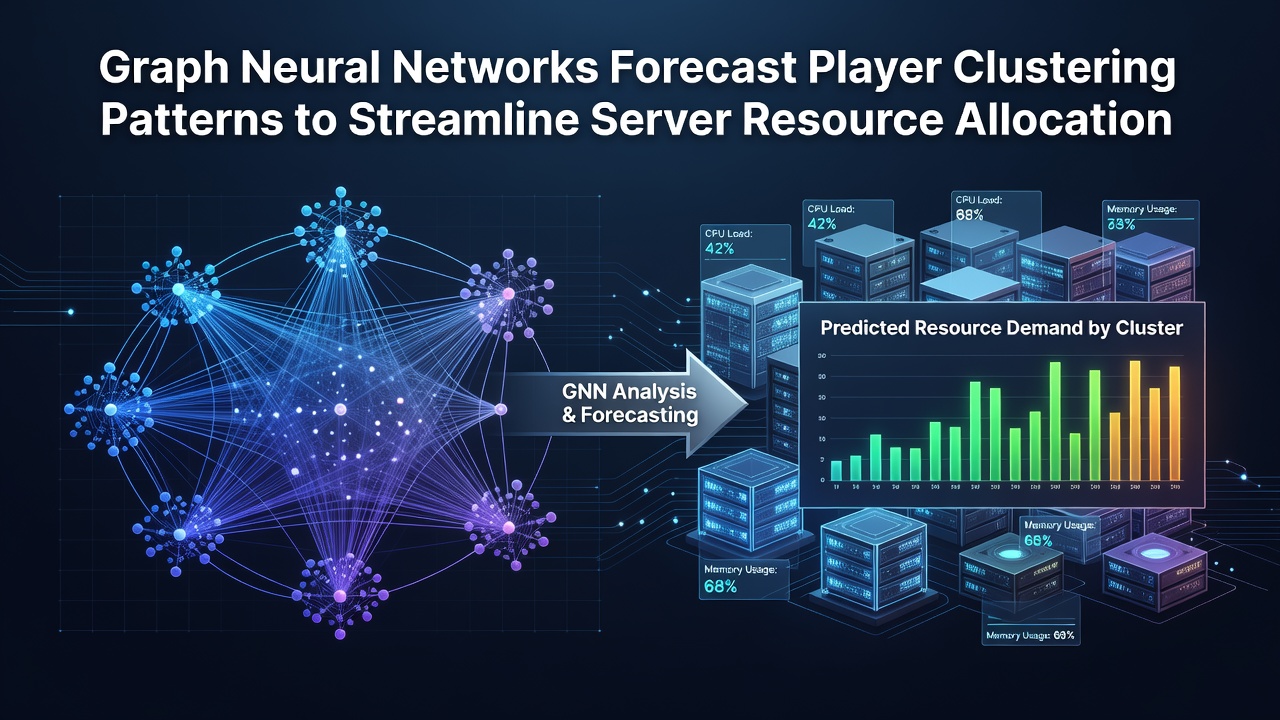
Industry reports compiled by European research consortia document efficiency gains when such pipelines operate continuously, particularly during peak evening hours when multiple time zones overlap. The same pipelines also feed visualization dashboards used by operations teams to monitor forecast confidence scores and intervene manually if model uncertainty rises above acceptable limits.
Developments Observed Through Mid-2026
By July 2026 several studios had expanded graph neural network usage beyond single titles to shared backend platforms that service multiple games within the same publisher portfolio, allowing cross-title pattern recognition that improves accuracy for shared mechanics such as cross-play lobbies. Academic papers presented at graphics and systems conferences during this period describe hybrid architectures that combine graph convolutions with attention mechanisms to handle noisy or incomplete telemetry streams common in mobile client scenarios.
Those implementations further demonstrate that periodic retraining on fresh data maintains performance as player behavior shifts with new content releases or meta changes, and automated pipelines now handle much of the labeling through anomaly detection rather than relying solely on manual annotation. Government-funded technology transfer programs in North America and Asia have supported open-source releases of core graph processing libraries tailored for gaming workloads, accelerating adoption among smaller studios that lack large internal research teams.
Operational Considerations and Limitations
Latency requirements demand that inference completes within tight windows, so practitioners prune graphs to retain only the most recent interactions and employ sampling techniques that preserve structural properties while reducing computational load. Privacy regulations in multiple jurisdictions require that raw player identifiers undergo anonymization before entering training sets, yet the relational structure itself remains intact for model learning purposes.
Engineers address edge cases such as sudden mass logins during promotional events by maintaining fallback heuristics that activate when model output confidence drops, and post-event audits compare predicted versus actual allocations to refine future iterations. Data shows these combined approaches reduce over-provisioning incidents while keeping under-provisioning events below thresholds that would affect player experience metrics tracked by publishers.
Conclusion
Graph neural networks continue to supply actionable forecasts of player clustering that enable more precise server resource allocation across massive online worlds, and ongoing refinements in model architecture alongside cloud tooling support wider deployment as of mid-2026. The integration of relational learning with operational systems illustrates how specialized machine learning techniques address concrete infrastructure challenges in the gaming sector.