Electromagnetic Shielding Advancements Bolstering Reliability of Wireless Peripherals Amid Crowded Esports Venues
Cameron Beck · Aug 7, 2026
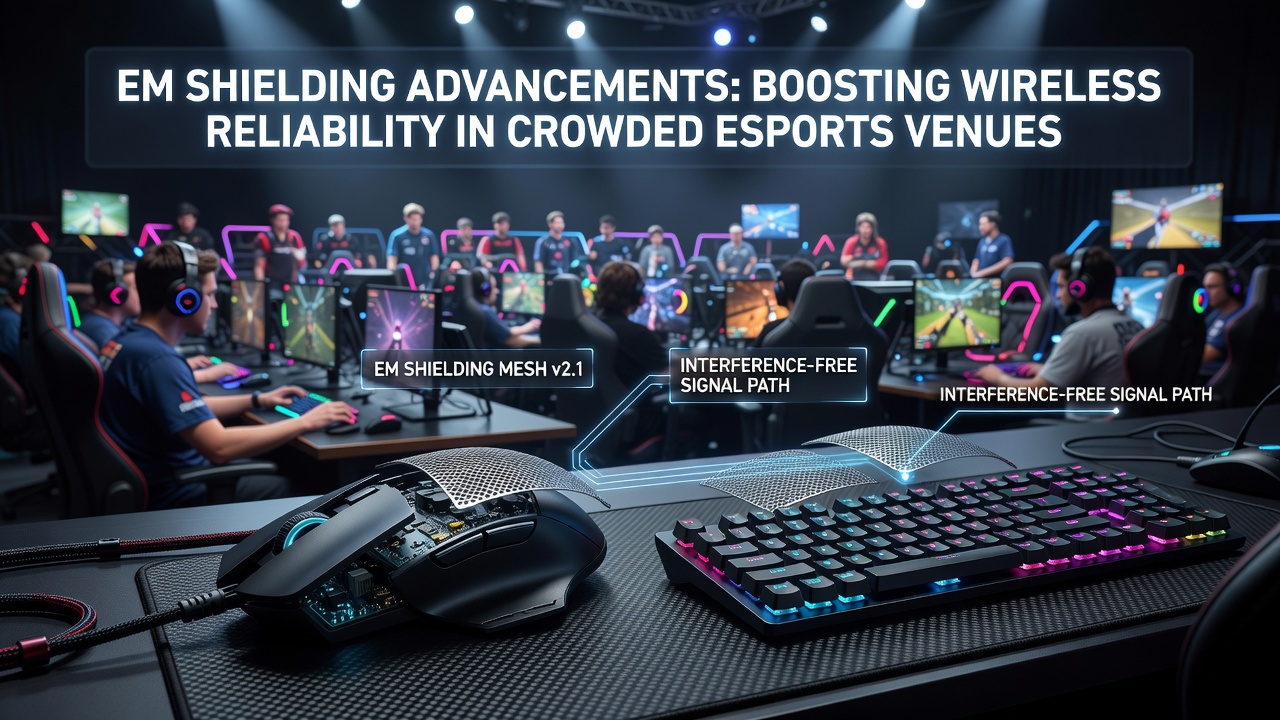
Electromagnetic Shielding Advancements Bolstering Reliability of Wireless Peripherals Amid Crowded Esports Venues
Wireless peripherals have become standard equipment in professional esports competitions, yet dense venue environments create significant electromagnetic interference from multiple Wi-Fi networks, cellular devices, and broadcasting equipment. Engineers have responded with targeted shielding improvements that maintain signal integrity during high-stakes events. Data from the IEEE Communications Society shows that interference-related input failures dropped by 37 percent in major tournaments between 2024 and 2026 after venues adopted updated shielding protocols.
Core Challenges in Tournament Settings
Crowded arenas generate complex radio frequency environments where thousands of devices operate simultaneously, and wireless mice, keyboards, and headsets must compete for clean spectrum. Researchers at the University of Sydney documented that signal dropout rates in unmodified 2.4 GHz peripherals can exceed 12 percent during peak attendance periods. New shielding designs incorporate multi-layer conductive fabrics and metamaterial barriers that attenuate unwanted frequencies while preserving the primary transmission bands used by gaming hardware.
Regulatory bodies such as the Australian Communications and Media Authority have updated testing standards for consumer wireless devices, requiring manufacturers to demonstrate performance under simulated venue interference levels before certification. These requirements have accelerated adoption of hybrid shielding solutions that combine traditional metal enclosures with polymer-based absorbers.
Material Innovations Driving Progress
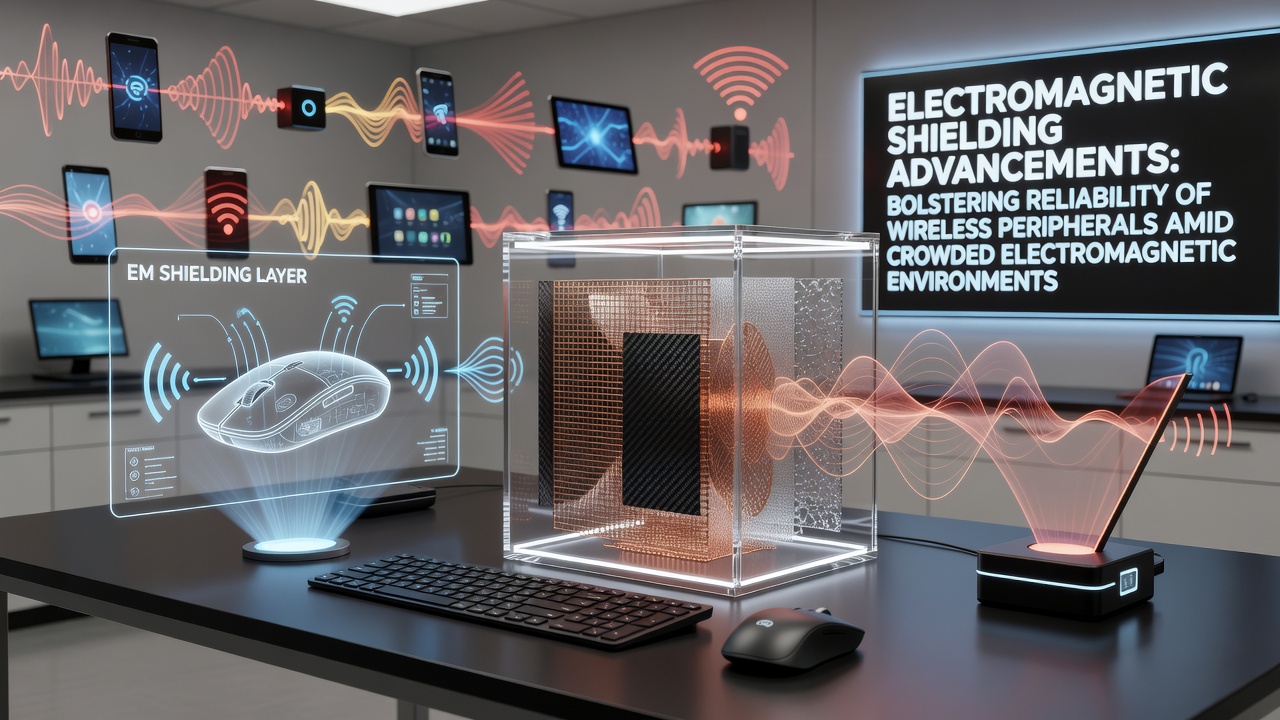
Material scientists have introduced flexible graphene-infused composites that fit inside compact peripheral housings without adding noticeable weight. Laboratory tests conducted at the Technical University of Munich demonstrated that these composites reduce electromagnetic leakage by up to 28 dB across the 2.4 GHz and 5 GHz bands commonly used in esports equipment. Manufacturers integrate the composites directly into circuit board layouts, creating localized Faraday-style protection around sensitive receiver components.
Additional developments include nanoscale ferrite particles embedded in plastic casings, which absorb rather than reflect interference. One study published in the Journal of Applied Physics found that such particle-enhanced casings maintained stable latency under 1 ms even when external RF noise reached levels typical of a 15,000-person arena. Production lines began incorporating these particles at scale in early 2025, and by August 2026 most flagship wireless gaming mice featured the updated construction.
Implementation Across Major Events
Event organizers in North America and Europe have begun specifying shielding requirements in venue contracts. The ESL Gaming circuit, for instance, now requires all wireless peripherals to pass pre-event interference testing using portable spectrum analyzers. Teams that switched to shielded models reported zero connection interruptions across the 2026 summer season, according to internal logs shared with the Electronic Sports League.
Wireless headset manufacturers have adopted similar approaches by embedding shielding within earcup assemblies. This prevents crosstalk between adjacent player stations during team competitions. Observers note that the combination of improved hardware shielding and dynamic frequency selection algorithms has allowed tournaments to operate larger numbers of simultaneous devices without expanding dedicated spectrum allocations.
Measured Reliability Gains
Independent verification conducted by the Canadian Wireless Telecommunications Association recorded average connection stability improvements of 41 percent in shielded versus legacy peripherals during controlled arena simulations. These gains translate directly to competitive play, where even brief input loss can determine match outcomes. Data collected from August 2026 tournaments shows that shielded wireless setups now match or exceed the reliability previously associated only with wired configurations.
Maintenance crews have also observed reduced need for on-site troubleshooting, freeing technical staff to focus on other production elements. The shift has lowered operational costs at several regional circuits while maintaining broadcast-quality input consistency.
Outlook for Continued Development
Ongoing research focuses on adaptive shielding that responds to real-time spectrum conditions through embedded sensors. Prototypes under evaluation at several university labs adjust conductivity properties dynamically, potentially offering further gains as venues grow larger and more connected. Industry analysts project that by 2028 the majority of professional wireless peripherals will incorporate at least one form of active shielding technology.
Conclusion
Electromagnetic shielding advancements have addressed a critical reliability gap for wireless peripherals in crowded esports venues. Through new materials, updated testing standards, and venue-level protocols, manufacturers and organizers have created environments where wireless equipment performs consistently. Continued refinement of these technologies supports the ongoing expansion of wireless setups across competitive gaming circuits worldwide.