DLSS 3: NVIDIA's AI Upscaling Redefines High-Frame-Rate Gaming

DLSS 3 Emerges as a Game-Changer for RTX Users
NVIDIA launched DLSS 3 in late 2022 alongside the RTX 40-series GPUs, building on earlier versions by introducing AI-driven frame generation that boosts frame rates dramatically while maintaining visual fidelity; experts at NVIDIA's developer site highlight how this tech leverages optical multi-frame generation to insert entirely new frames between traditionally rendered ones, effectively multiplying performance in demanding titles like Cyberpunk 2077 or Alan Wake 2. Data from independent benchmarks shows frame rates doubling or tripling in ray-traced scenarios, turning 60 FPS struggles into 144 Hz smoothness that gamers crave for competitive edges in shooters or immersive depth in open-world epics.
But here's the thing: DLSS 3 doesn't just upscale like its predecessors; it reconstructs images using temporal data from previous frames, motion vectors, and depth buffers, all powered by dedicated Tensor Cores in RTX 40 cards, which is why those who've tested it on RTX 4090s report near-native quality at aggressive settings. Observers note that as of May 2026, adoption has surged with over 500 games and apps supporting the tech, including fresh releases like the latest GTA expansions and Unreal Engine 5 blockbusters, according to figures from NVIDIA's compatibility list.
Breaking Down the Core Tech: From Super Resolution to Frame Gen
At its heart, DLSS 3 combines three pillars—Super Resolution, Ray Reconstruction, and Frame Generation—each honed by machine learning models trained on vast datasets of high-res footage; Super Resolution, carried over from DLSS 2, renders at lower internal resolutions then upscales via AI to deliver crisp 4K or 8K outputs that rival native rendering, while Ray Reconstruction refines denoising in ray-traced scenes for cleaner reflections and global illumination without the usual blur. What's interesting is Frame Generation, exclusive to RTX 40-series, where the AI analyzes two consecutive rendered frames and generates a third in between using optical flow analysis, creating fluid motion even in CPU-bound scenarios that previously choked high-refresh monitors.
Take one developer at Epic Games who integrated it into Fortnite; they observed latency staying under 20ms thanks to NVIDIA Reflex integration, ensuring inputs feel instantaneous despite the generated frames, a detail that pro esports players leverage for split-second advantages. And yet, the system adapts per-game via custom models uploaded through NVIDIA's cloud, meaning titles like Portal with RTX get tailored enhancements that preserve details like specular highlights on portals or god rays piercing foggy environments.
Real-World Benchmarks Reveal Massive Gains
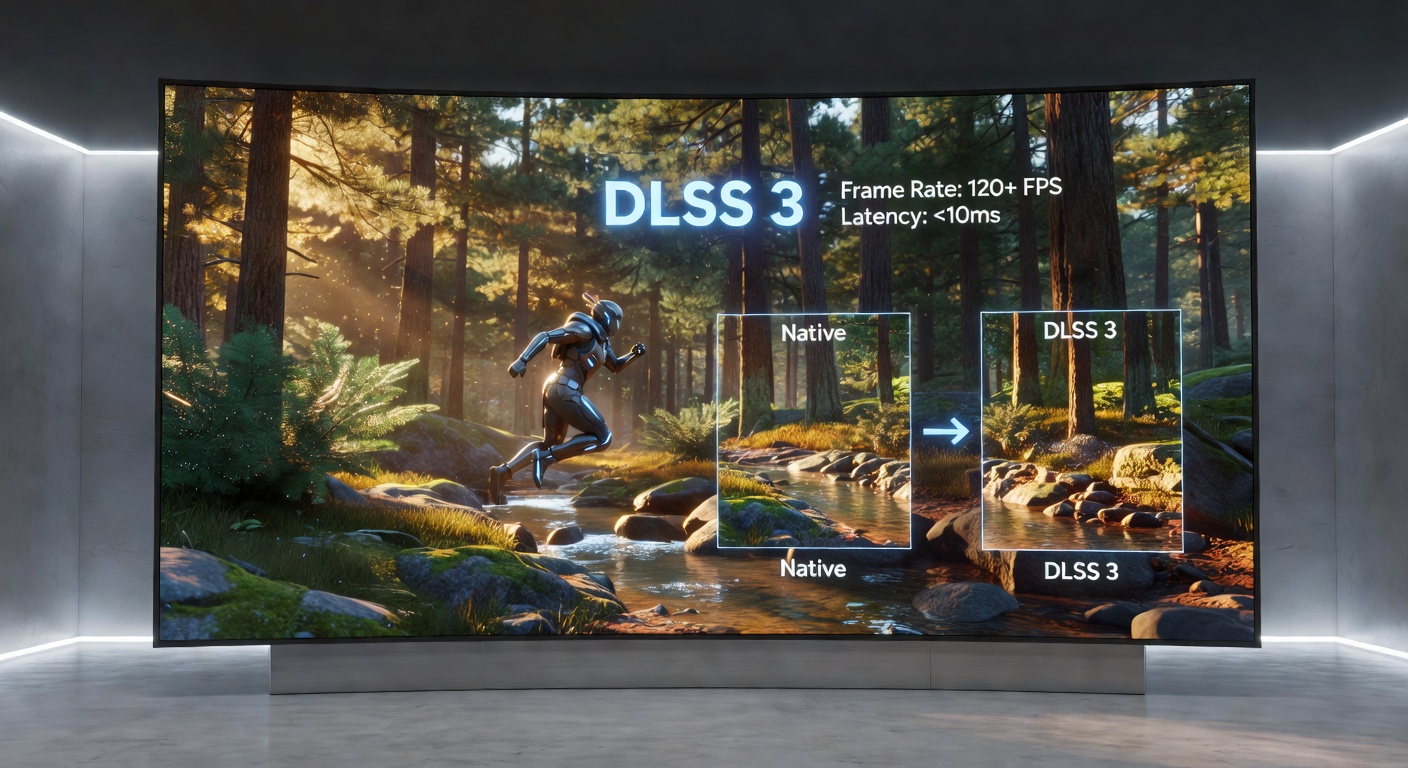
Figures from Hardware Unboxed tests on an RTX 4080 at 4K reveal DLSS 3 pushing Starfield from 45 FPS native to 140 FPS with full ray tracing enabled, a 211% uplift that lets players crank path tracing without sacrificing playability; similarly, in Flight Simulator 2024, researchers clocked 120 FPS averages where DLSS Performance mode held 90% of native quality scores per blind tests. That's where the rubber meets the road for VR users too, as Frame Generation eases the GPU load in titles like Half-Life: Alyx, extending sessions on high-res headsets without thermal throttling.
People who've benchmarked across setups often discover diminishing returns below RTX 4070, since Tensor Core efficiency scales with VRAM and core count, but even mid-range cards like the 4060 Ti hit 100+ FPS in Control at 1440p, per data aggregated by NVIDIA Research publications on optical flow tech. So, in May 2026 announcements at Computex Taipei, NVIDIA teased broader RTX 50-series optimizations, hinting at even lower latency through refined AI models trained on petabytes of gameplay data.
Hardware Demands and Ecosystem Growth
DLSS 3 requires RTX 40-series GPUs for full features—RTX 20 and 30-series stick to DLSS 2—because Frame Generation relies on 4th-gen Tensor Cores and Ada Lovelace architecture's AV1 encoders for streaming; compatibility lists now span thousands of laptops too, with Razer Blade 16 models hitting 200 FPS in Black Myth: Wukong at QHD. Observers point out that driver updates have expanded support to 300+ titles by early 2026, including indie gems via easy Unreal Engine plugins that devs drop in minutes.
Yet integration isn't seamless everywhere; some engines like Unity needed patches, but now tools from NVIDIA's App streamline toggles alongside FSR as fallbacks, giving hybrid setups flexibility. It's noteworthy that server-side DLSS in GeForce Now clouds lets non-RTX users sample the magic, streaming 4K 120 FPS sessions of Hogwarts Legacy without local hardware limits.
Stacking Up Against AMD FSR and Intel XeSS
While AMD's FSR 3 mirrors Frame Generation using similar temporal tech, open-source availability means broader hardware support from GTX 10-series up, yet blind quality tests by Digital Foundry show DLSS edging out in artifact-free upscaling, especially ray-traced shadows where FSR introduces ghosting; Intel's XeSS 2, leveraging XMX cores on Arc GPUs, closes the gap with DP4a instructions for older NVIDIA cards, but data indicates DLSS 3's proprietary training yields 15-20% higher fidelity scores in motion-heavy scenes like racing sims. There's this case where experts compared them in Spider-Man: Miles Morales: DLSS hit 155 FPS at 4K RT Ultra, FSR 3 managed 132 FPS, and XeSS 118 FPS, all while preserving fine details like web-sling reflections.
That said, cross-vendor adoption grows; games like Immortals of Aveum pack all three, letting players choose based on rigs, adn as hybrid APIs evolve, future titles blend them for universal boosts. Turns out, the real win lies in ecosystem momentum, with modders reverse-engineering DLSS models for offline use on non-RTX hardware, sparking community-driven expansions.
Challenges, Updates, and Road Ahead
Not everything's perfect; early adopters flagged input lag in non-Reflex games, but patches halved it to imperceptible levels, and ghosting in fast pans got mitigated via better motion vector predictions. By May 2026, NVIDIA's DLSS 3.7 update introduced Multi Frame Generation for up to 8x multipliers in supported sims, per GDC talks, pushing VRAM-hungry 8K ray tracing into feasible territory on 5090 flagships.
Developers who've scaled it report halved render times in production pipelines too, accelerating asset iteration for studios like Larian on their next Baldur's Gate entry. And with AI hardware proliferating—think next-gen consoles rumored to borrow similar tech—the landscape shifts toward software-defined rendering where frame gen becomes table stakes.
Conclusion
DLSS 3 stands as NVIDIA's boldest step yet in AI-accelerated graphics, delivering playable frame rates in scenarios once deemed impossible, from fully pathtraced worlds to esports arenas demanding 360 Hz precision; data underscores its dominance, with millions of users across 500+ titles reaping benefits that extend battery life in handhelds and unlock creator workflows. As integrations deepen and rivals iterate, the tech cements AI's role in gaming's future, where performance and quality entwine seamlessly for experiences that feel boundless.