Ceramic Components Stabilizing Voltage Rails Across High Performance Graphics Cards During Prolonged Benchmark Runs
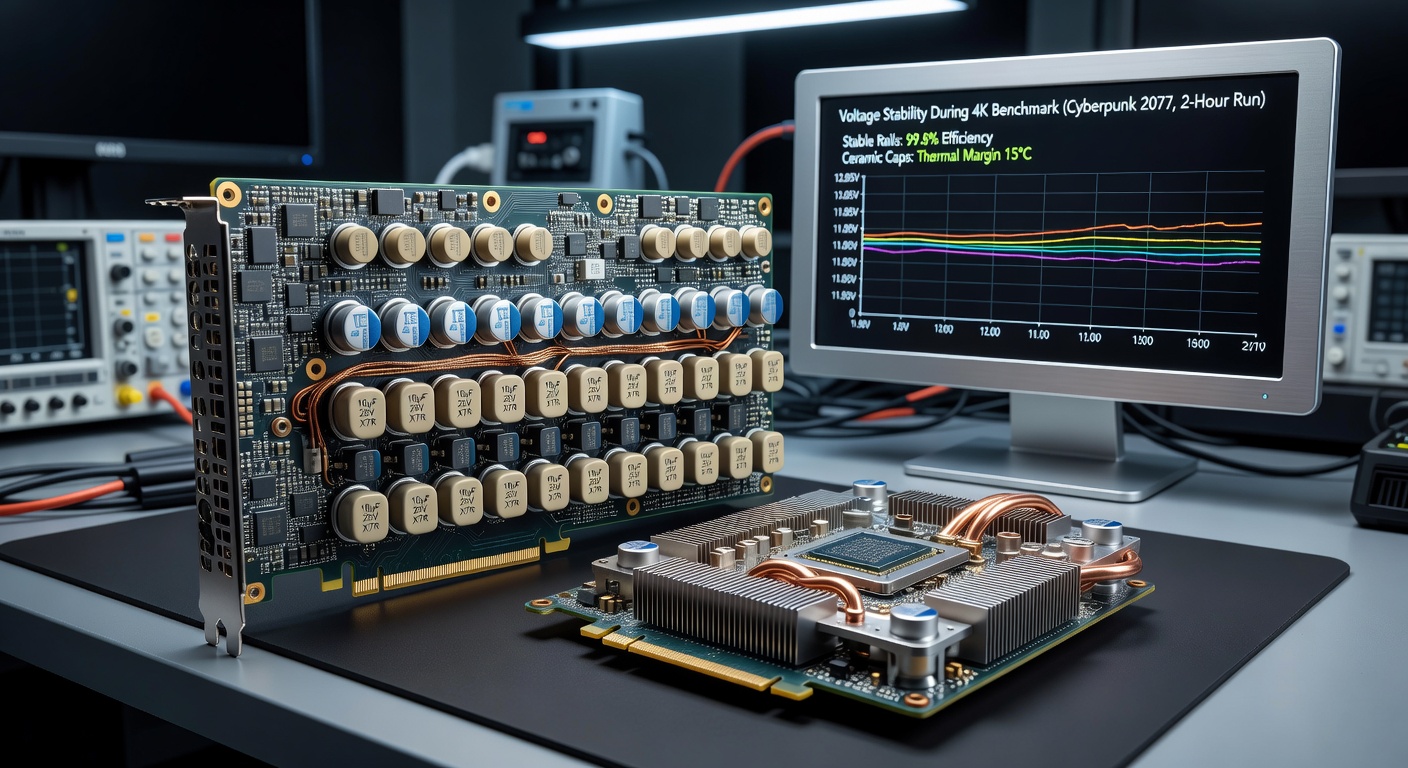
High-performance graphics cards rely on stable voltage delivery to maintain consistent operation when subjected to extended computational loads such as those found in benchmark suites, and ceramic components play a central role in achieving that stability across multiple voltage rails. Engineers design these components into the power delivery networks of GPUs from major manufacturers, where they manage transient currents and minimize fluctuations that could otherwise lead to throttling or instability during sessions lasting several hours.
Role of Ceramic Materials in Modern GPU Power Systems
Multi-layer ceramic capacitors, often abbreviated as MLCCs, form the backbone of decoupling networks on graphics card PCBs because their dielectric properties allow high capacitance density in compact packages while exhibiting low equivalent series resistance. These devices sit directly adjacent to GPU cores and memory modules, absorbing rapid changes in current demand that occur when shaders execute complex workloads in tools like 3DMark or FurMark. Research from materials laboratories shows that class II ceramic formulations maintain effective capacitance even as temperatures rise during sustained operation, unlike some electrolytic alternatives that degrade faster under heat.
Inductors paired with ceramic capacitors in voltage regulator modules further refine the output waveform, creating a filtering network that keeps rail voltages within tight tolerances specified by GPU designers. Data collected from power integrity tests indicate that boards incorporating higher volumes of X7R or X5R dielectric ceramics exhibit measurably lower voltage ripple amplitudes across the 12-volt input and core voltage domains when benchmark loops run continuously for more than sixty minutes.
Performance Under Extended Load Conditions
Benchmark protocols push graphics processors to near-maximum utilization for durations that mirror or exceed typical gaming sessions, revealing how ceramic components respond to cumulative thermal and electrical stress. Engineers at card assembly facilities monitor rail stability through oscilloscope traces taken at multiple points along the power path, and results consistently demonstrate that ceramic-based filtering reduces peak-to-peak deviations that might otherwise trigger protective shutdowns. In May 2026, updated testing guidelines from industry consortia began incorporating longer continuous-run profiles to better reflect real-world usage patterns in data centers and enthusiast systems alike.
Thermal imaging of populated boards reveals that ceramic capacitors distribute heat more evenly across their surfaces compared with polymer alternatives, which helps prevent localized hotspots near sensitive silicon dies. This characteristic proves especially relevant when multiple high-current rails operate simultaneously, as occurs in flagship models equipped with 16-phase or greater power stages. Observers note that boards using advanced ceramic stacks maintain tighter voltage margins throughout multi-hour runs, supporting higher sustained clock speeds without external intervention.
Integration Trends Across Major GPU Architectures
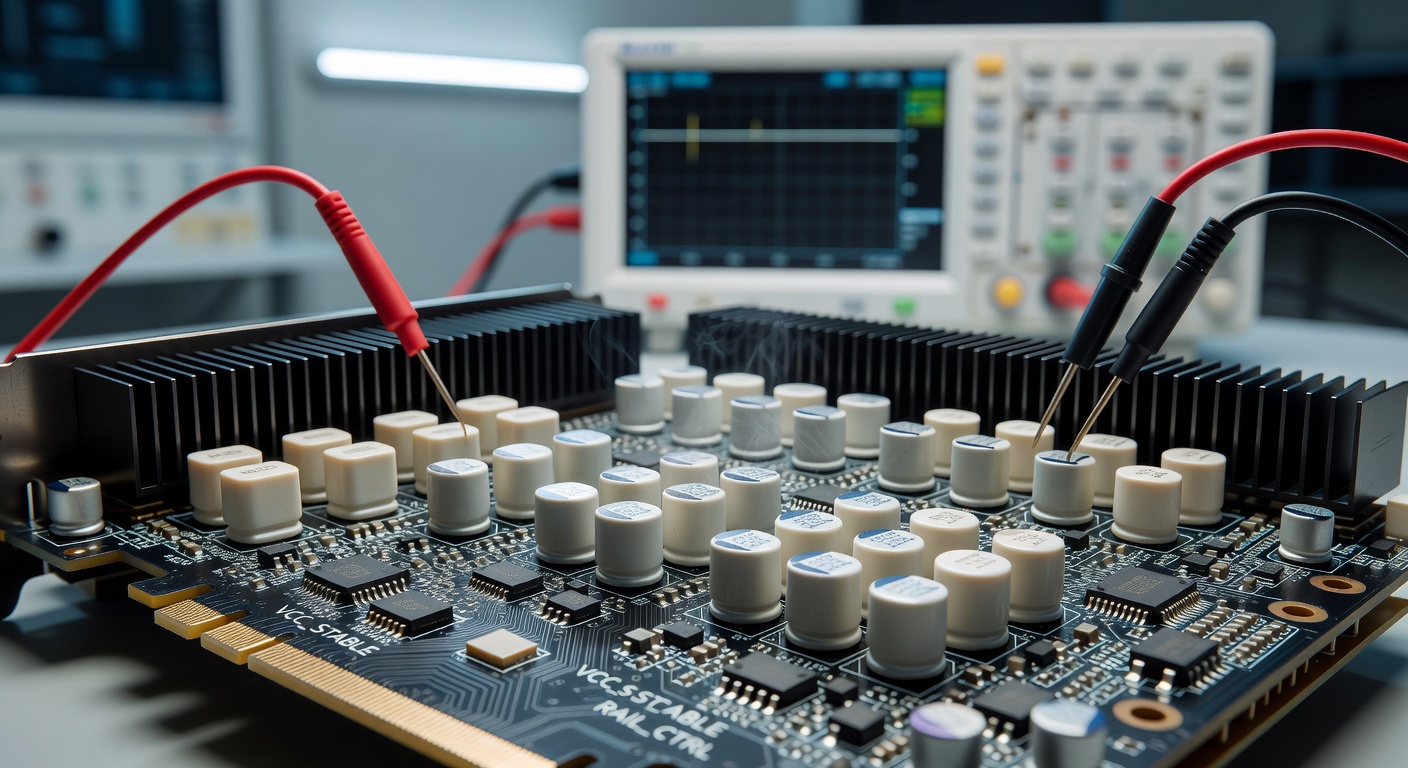
Design teams at both discrete GPU vendors and add-in-board partners have increased the count and quality grade of ceramic passives in successive product generations to address rising power densities. Current-generation cards allocate additional board real estate for arrays of 0805 and 1206 case-size MLCCs rated for higher voltage and temperature ranges, directly supporting the current demands of memory subsystems and auxiliary controllers. Figures released by electronics manufacturing groups show a measurable uptick in ceramic component usage per board between 2024 and 2026, correlating with the shift toward wider memory buses and higher transistor counts.
Power delivery simulations performed at university research centers confirm that optimized ceramic networks reduce impedance peaks at frequencies corresponding to GPU switching transients, which in turn lowers the risk of electromagnetic interference affecting nearby circuitry. These models also predict improved long-term reliability when ceramic parts replace older capacitor technologies in positions exposed to repeated thermal cycling. Manufacturers incorporate such findings into layout revisions that appear on retail products released throughout 2026.
Measurement Standards and Industry Data
Standardized procedures developed by international electronics organizations now require extended benchmark intervals when qualifying new graphics hardware for commercial release, and ceramic component performance forms a key evaluation criterion. Reports compiled by research institutions document average voltage deviation reductions of several millivolts when boards utilize premium ceramic grades versus baseline configurations. A study accessible through NIST publications outlines measurement techniques that capture these improvements under controlled thermal conditions.
Additional validation comes from collaborative work between European technical institutes and component suppliers, where accelerated life testing subjects populated PCBs to repeated benchmark cycles while logging rail parameters. Results indicate that ceramic networks retain specification compliance longer than comparable assemblies relying on other dielectric types. Graphics card vendors reference these datasets when publishing power specifications and recommended operating durations for their flagship models.
Conclusion
Ceramic components continue to underpin voltage rail stability in high-performance graphics hardware as benchmark workloads grow more demanding, with ongoing refinements in material formulations and placement strategies supporting reliable operation across extended test intervals. Industry measurement programs scheduled for late 2026 will likely expand data collection on these elements, providing further insight into their contribution to overall system resilience.