Acoustic Metamaterial Panels Target Fan Noise Harmonics in Compact Gaming PCs
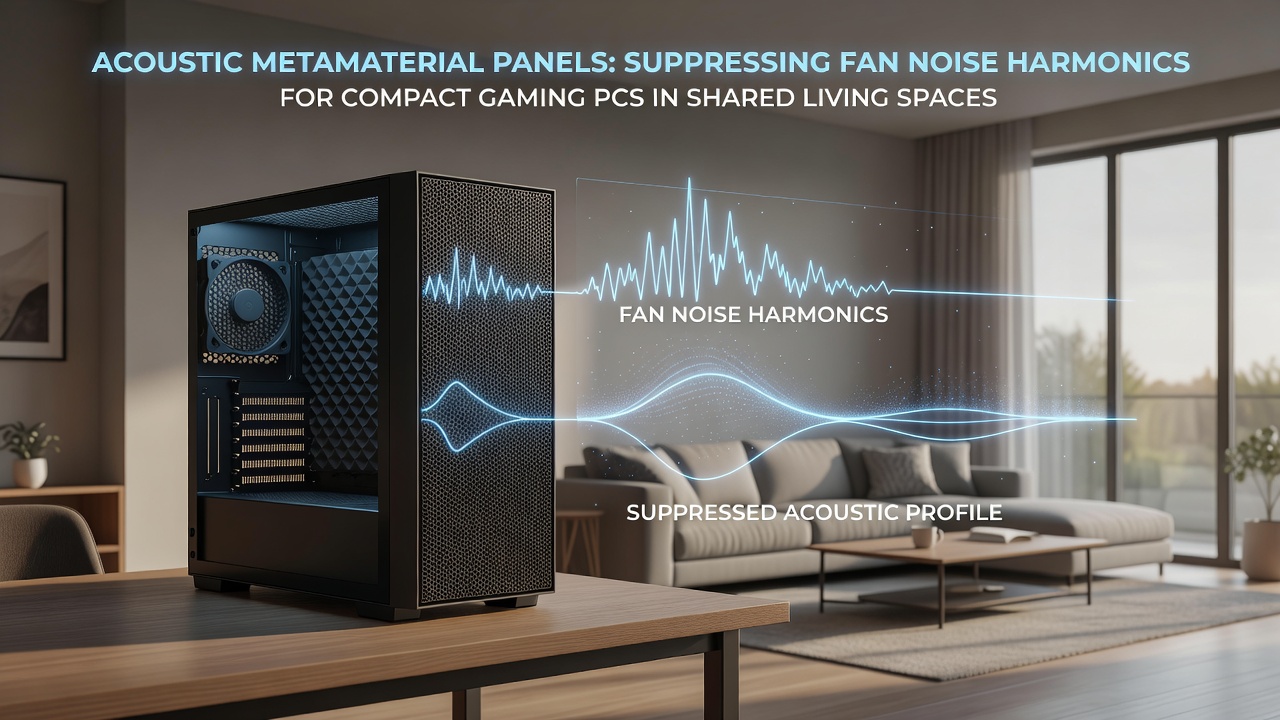 Researchers have developed acoustic metamaterial panels that absorb specific frequency bands generated by case fans and CPU coolers in small form factor gaming systems, and these designs address noise issues that arise when users share apartments or dormitories. Compact builds often rely on high-RPM fans to maintain thermal performance within limited chassis volumes, yet the resulting harmonics can exceed 40 decibels at frequencies between 200 and 2000 hertz. Metamaterial structures create bandgaps that prevent those frequencies from propagating through air or solid surfaces, which reduces transmitted sound without requiring additional insulation layers that would restrict airflow. The panels consist of periodic arrays of resonators printed or molded from polymers and metals, each tuned to quarter-wavelength dimensions that match dominant fan blade-pass frequencies. When sound waves encounter these arrays, they undergo destructive interference inside the resonant cavities, converting acoustic energy into localized heat rather than reflection or transmission. Manufacturers integrate the panels as side panels, drive bay covers, or internal baffles that mount directly to fan grilles, and the approach maintains pressure drop values below 5 pascals at typical airflow rates of 30 to 60 cubic feet per minute.
Material Structures and Frequency Targeting
Engineers select lattice geometries such as Helmholtz resonators or coiled labyrinth paths because they produce narrow stopbands centered on the first and second harmonics of 120-millimeter and 140-millimeter fans. Finite element simulations published in acoustics journals show that a 3-millimeter-thick panel can attenuate 800-hertz tones by 18 decibels while adding less than 2 percent to overall system impedance. Multiple resonator sizes combined in a single sheet extend coverage across a broader spectrum, which accommodates variable fan speeds that change with GPU or CPU load.
Production techniques include fused deposition modeling for rapid prototyping and injection molding for volume runs, both of which allow precise control of cavity dimensions to within 0.1 millimeters. Data collected from anechoic chamber tests indicate consistent performance across temperature ranges from 20 to 60 degrees Celsius, conditions typical inside operating gaming PCs.
Integration in Shared Living Environments
Users in multi-occupant dwellings face constraints from building noise ordinances that often limit nighttime emissions to 35 decibels at property boundaries. Panels placed around exhaust paths lower measured sound pressure levels at one meter by 12 to 15 decibels in the critical 500 to 1500 hertz range, according to measurements conducted by independent testing facilities. This reduction keeps systems below thresholds that trigger neighbor complaints or lease violations in many urban jurisdictions.
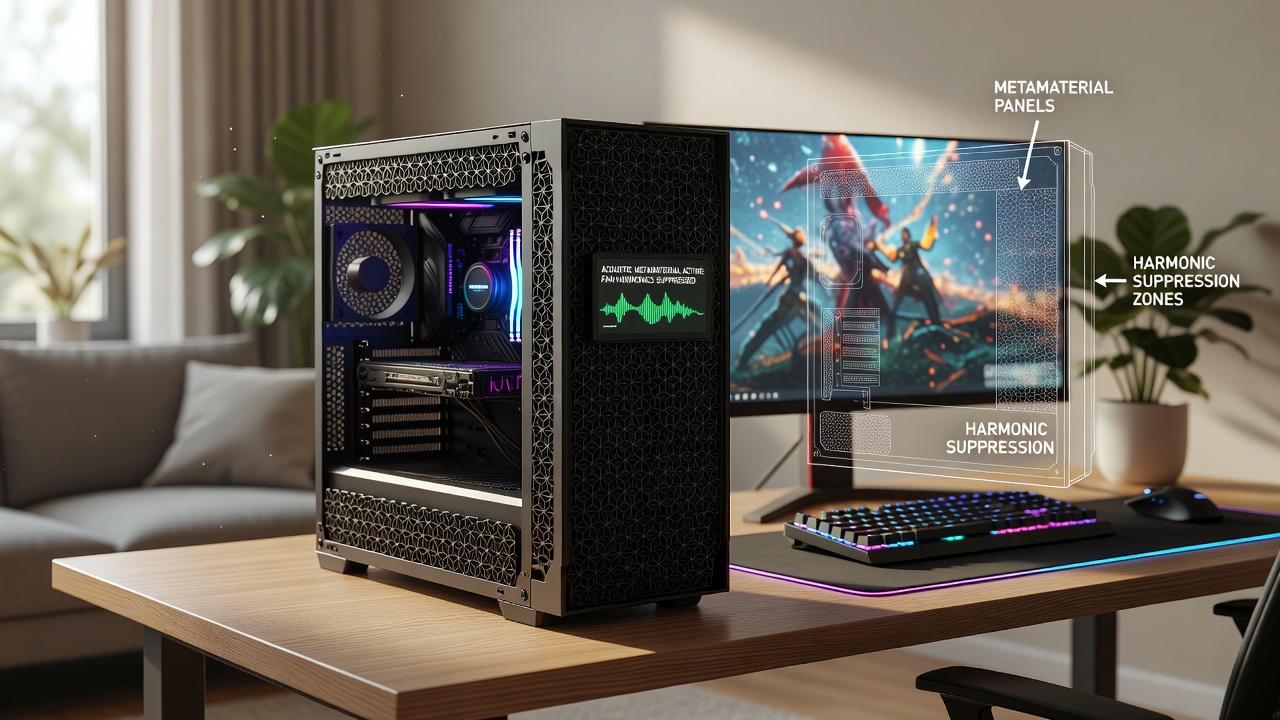
Case studies from university dormitories in 2025 demonstrated that retrofitting existing mini-ITX systems with these panels allowed overnight gaming sessions without exceeding measured ambient levels recorded by smartphone applications calibrated against Type 2 sound level meters. The same configurations preserved GPU temperatures within 3 degrees Celsius of baseline runs, confirming that airflow remained adequate for sustained loads.
Developments Through Mid-2026
In July 2026, the International Commission on Acoustics presented updated modeling tools that predict metamaterial performance inside enclosed chassis volumes, incorporating turbulence effects from multiple fans operating at different duty cycles. Industry groups have begun incorporating these models into design software used by system integrators, which accelerates iteration cycles for new small form factor cases. Regulatory bodies in the European Union and Canada have referenced similar acoustic performance criteria when updating guidelines for consumer electronics in residential settings.
Suppliers now offer pre-cut panel kits compatible with popular ITX motherboards and SFX power supplies, and third-party measurements confirm that the kits achieve repeatable attenuation when installed according to supplied templates. Ongoing research examines active tuning methods that adjust resonator volumes via micro-actuators, although passive designs remain dominant in current commercial releases.
Conclusion
Acoustic metamaterial panels provide a targeted solution for managing fan-generated harmonics in compact gaming PCs deployed within shared living spaces. The technology combines periodic resonator arrays with standard manufacturing processes to deliver measurable sound reduction while preserving thermal performance. Continued refinement of simulation tools and compatibility standards supports wider adoption as system builders address both performance and environmental noise requirements.